


Short answer: A 2 piece cue splits in the middle and packs into the shortest case. A 3/4 cue splits 12 to 16 inches from the butt, so the shaft is unbroken through your stroke. A 1-piece has no joint at all. Choose on how you play and how you travel.
By Andy Gibson · Updated 18 October 2026

What is the difference between a 2 piece and a 3/4 cue?
Where the joint sits. Both come apart into two pieces, which is why our 3/4 cues are listed as "2-Piece 3/4 Split". In everyday use, though, "2-piece" means a centre-joint cue.
- 2-piece (centre joint). The joint sits in the centre of the cue, between your bridge hand and your grip hand. Each half is about half the cue's length.
- 3/4 split. The joint sits low in the butt, roughly 12 to 16 inches from the butt end depending on the maker. The Powerglide Paramount in our range is typical: a 108 cm shaft and a 37 cm butt. Everything from the tip back past your bridge hand is one length of shaft.
- 1-piece. No joint. The cue is one continuous length from tip to butt.
On quality cues the joint is brass, as on the Paramount, the Diamond Centenary and the Palko PX2. Better cues also match the timber grain across the joint, so the shaft reads as one piece of wood: the Powerglide Swerve's feathering runs continuously when the cue is put together.
1-piece, 2-piece and 3/4 split compared
| Construction | Where it splits | Case it needs (57in cue) | Extension | Best for |
|---|---|---|---|---|
| 1-piece | Doesn't split | Full length: 57in case or sleeve | Only if the butt has an extension joint | A home table, the club, juniors |
| 2-piece (centre joint) | Middle of the cue | Shortest: a 32 to 34in case | On cues with a butt-end joint | Pool leagues, travel, a first cue |
| 3/4 split | 12 to 16in from the butt | Longer: a 3/4 split case, sized for the long shaft | Butt-end joint on most; on some, a mini butt fits the shaft for a short cue | Snooker, players who want an unbroken shaft and still need to carry the cue |
Is a 1-piece cue better than a 2-piece?
Not for the game itself. A well-made joint doesn't stop a cue playing well, and no cue maker publishes a measured difference in how a good jointed cue plays against a one-piece. The differences are practical:
- No joint to look after. Nothing to wear, loosen or seat properly. Our club and pub cues are 1-piece for the same reason: they live on a rack and get used by everyone.
- Harder to carry. A full-size cue is 57in (about 145 cm), so it needs a full-length case or sleeve.
- Range. Our 1-piece cues run from fibreglass and maple club cues up to the hand-made Palko PX1 in ash.
If the cue lives at home next to the table, a 1-piece is the simplest choice.

Choose your option
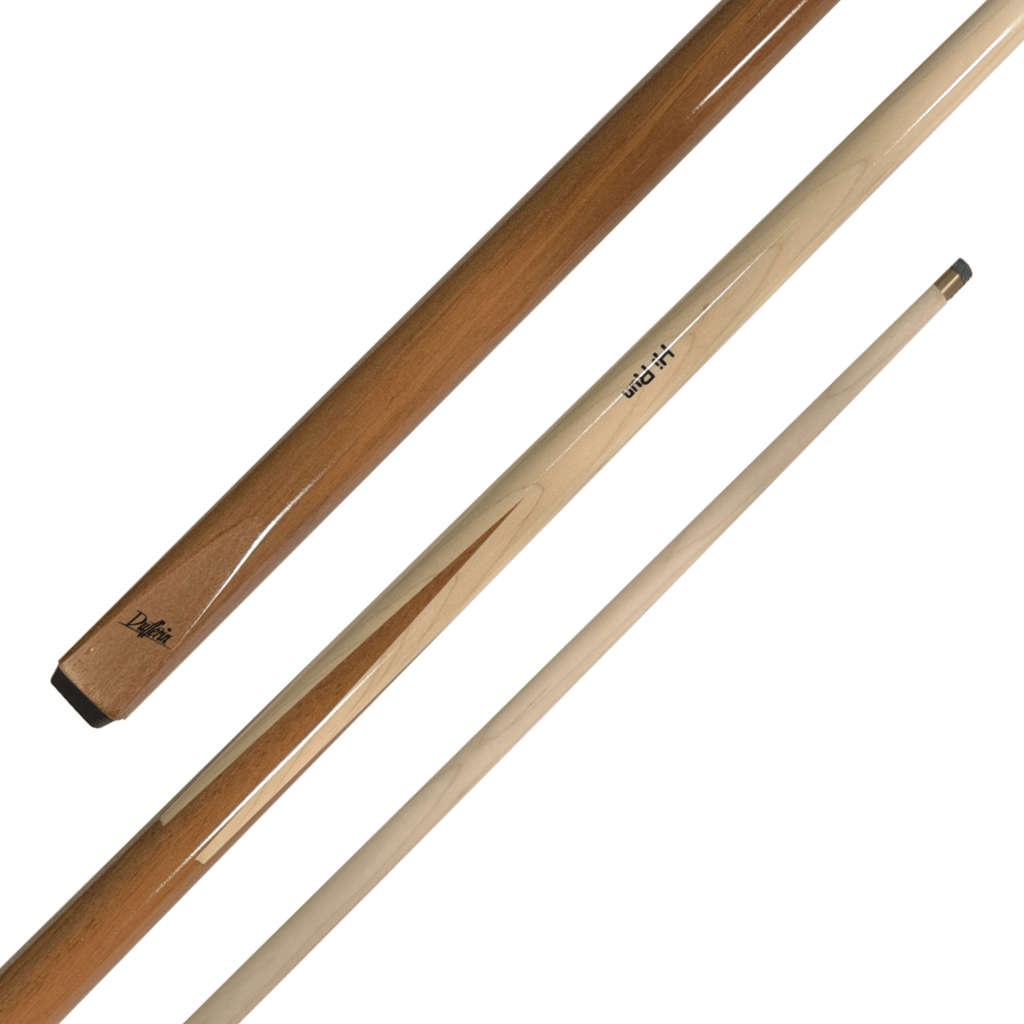
Choose your option

Choose your option
Why choose a 2-piece cue?
A centre-joint cue breaks down into two halves of about 28in each, so a 57in cue fits a 32in hard case. That suits anyone who carries a cue to a league night, a club or a holiday house. It's also the most common construction in our range, about three cues in four, including the AFL and NRL team cues and the Grafex multi-weight graphite cues.
Many 2-piece cues also have a joint in the end of the butt for an extension. Some come with the extension included, such as the Formula Sports High Performance with its 6in extension.

Choose your option

Choose your option

Supreme - 2-Piece Multi Weight Graphite Cue


Choose your option


Choose your option
What is a 3/4 cue, and why do snooker players use them?
A 3/4 split (or 3/4 jointed) cue splits near the butt instead of in the middle. The joint sits behind the part of the cue you sight along and bridge over, so the shaft is one piece of timber all the way from the tip past your bridge hand. That's the reason players who want the feel of a one-piece choose it, and it's the traditional construction for snooker cues.
It still comes apart. The shaft of a 57in 3/4 cue is about three-quarters of its length (108 cm on the Paramount), so it needs a longer case than a 2-piece, but it's carried by hand the same way.
The 3/4 joint has one more use. On some cues a short extension, called a mini butt, screws into the shaft in place of the butt to make a shorter cue for shots near a wall. Check the maker's details before you buy one for this; not every 3/4 cue's joints match.


Choose your option

Choose your option

Stryker - 2-Piece 3/4 Split Hand Made Ash Cue With Extension & Case
Choose your option
Which cue construction is best for a small room?
Length matters more than construction. A table close to a wall leaves shots where a 57in cue can't be drawn back, whatever the joint. The usual answer is a second, shorter cue:
- A short cue. Cues of 36 to 48in, such as the 48in Palko PX4 3/4 split, are made for tight rooms and younger players. See the 36 to 48in cues.
- A mini butt on a 3/4 cue, where the cue's joints allow it (above).
The opposite problem, a shot too far away to reach, is solved with an extension on the butt-end joint. The Powerglide Paramount, for example, has a butt-end joint that takes Powerglide extensions.

PX4 - 2-Piece 3/4 Split Hand Made Ash Cue
Choose your option

Choose your option
Which construction suits you?
- Home table, cue stays in the room: 1-piece. Nothing to wear and nothing to assemble.
- Pool league, travel, or a first cue of your own: 2-piece centre joint. The smallest case and the widest choice.
- Snooker, or you want the shaft unbroken through the stroke: 3/4 split. It still breaks down for the car.
- Small room or a junior player: add a short cue of 36 to 48in, whatever your main cue is.
What case does each construction need?
Buy the case for the construction, not just the cue length. A 3/4 cue won't fit a 2-piece case, and a 2-piece case is too short for a 3/4 butt.


Choose your option

Choose your option

Choose your option
Whichever you choose, check it's straight before you buy and store it in its case: see how to check if a pool cue is straight.
Frequently asked questions
Is a 2 piece or 3/4 cue better?
Neither plays better as such. A 2-piece packs smaller; a 3/4 keeps the shaft unbroken from the tip past your bridge hand. Pool players often choose a 2-piece, snooker players a 3/4.
What does 3/4 split mean on a cue?
The cue splits about three-quarters of the way along from the tip, 12 to 16 inches from the butt end, instead of in the middle.
Is a 3/4 cue a 2-piece cue?
Yes. It comes apart into two pieces, which is why ours are listed as "2-Piece 3/4 Split". In everyday use "2-piece" means a centre-joint cue.
Does a joint make a cue play worse?
Not on a well-made cue. A solid brass joint that's screwed fully home plays as one cue. Choose on feel, carrying and price.
Can I put an extension on a 2-piece cue?
Yes, if the butt has an extension joint. Many 2-piece and 3/4 cues do; some come with the extension included.
How long is a full-size cue?
Most full-size cues in our range are 57in, about 145 cm. Short cues for small rooms and juniors run from 36 to 48in.
Will a 3/4 cue fit in a 2-piece case?
No. The 3/4 shaft is much longer than half the cue. Use a 3/4 split case.
Related guides
Shop the range
Shop 3/4 split cues

